

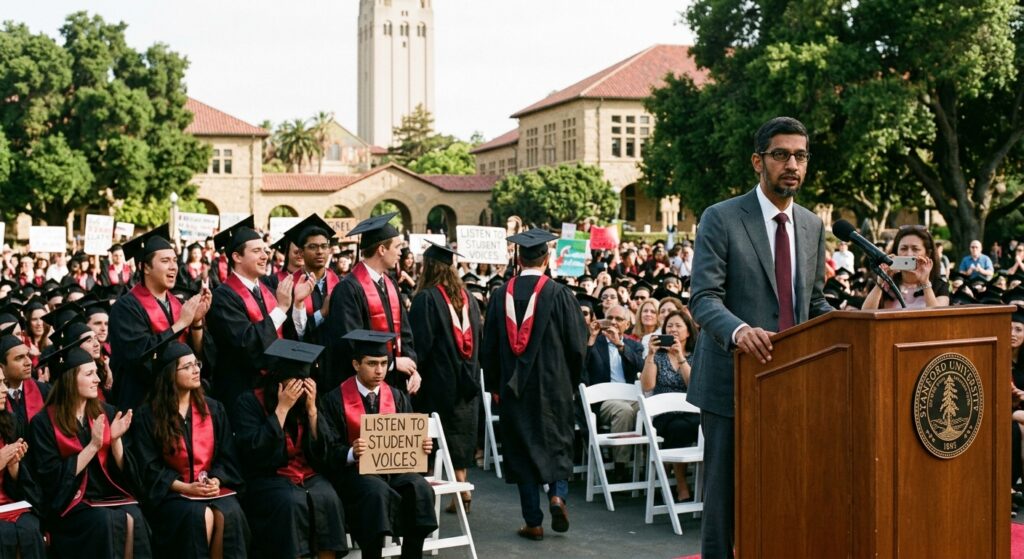
Last weekend, Google’s CEO Sundar Pichai stirred controversy during his commencement address at Stanford University, leading to protests from around 200 students who walked out in opposition to the company’s defense contracts, particularly Project Nimbus. The students expressed their discontent with placards and chants advocating for Palestinian freedom, highlighting increasing tensions surrounding tech companies’ involvement in military contracts amidst the ongoing conflict in Gaza.
The protests reflect deepening concerns among the younger generation about technological ethics, especially as it relates to corporate influence in warfare. This incident illustrates a larger trend as graduates across the nation increasingly vocalize their dissatisfaction with prominent figures and their respective corporate affiliations.
Introduction: A Controversial Commencement
Sundar Pichai, the CEO of Google, was met with considerable backlash during his recent commencement speech at Stanford University, an institution where he once earned his graduate degree. Approximately 200 students staged a walkout, alongside a chorus of boos directed towards Pichai, signaling a strong rejection of Google’s involvement in military contracts. The protests centered on concerns over Project Nimbus, a $1.2 billion initiative shared with Amazon to provide cloud and AI services to the Israeli military, as well as Google’s connections with U.S. Immigration and Customs Enforcement (ICE).
Student protestors displayed signs that clearly articulated their objections, with messages such as “ICE SPIES WITH GOOGLE AI” and “GENOCIDE RUNS ON GOOGLE.” This has underscored a growing unwillingness among the younger demographic to remain passive in the face of corporate practices they perceive as harmful. The timing of the protest is particularly significant, coinciding with heightened conflict in Gaza, which has spurred calls for accountability among technology giants.
Unpacking the Protests
The organized walkout was spearheaded by a coalition of activist groups including Stanford Students for Justice in Palestine and No Tech for Apartheid. Their unified stance echoed a broader sentiment prevalent within academia regarding corporate ethics and social responsibility. A statement issued in connection with the protest made it clear: “We are walking out because we refuse to glorify the corporations that fuel this violence and exercise our power to choose differently.” This profound moment reflects the students’ determination to hold influential figures accountable and to seek an alternative path that aligns with their values.
The backlash against Pichai was not just about AI hype or tech advancement; it was a vehement rejection of specific corporate decisions that students feel contribute to international conflicts. The recent conflict in Gaza has provoked ongoing protests against Google, with employees within the company also voicing dissent over the Nimbus project. Some believe such contracts only exacerbate humanitarian crises, fueling a cycle of violence and oppression.
Implications and Future Directions
This protest at Stanford could signal a pivotal shift in how corporations interact with younger generations poised to inherit the complexities of these technologies. The striking reactions from students reveal a discontent with corporate social responsibility and ethics, suggesting a demand for increased accountability from tech giants. Business leaders, including venture capitalist Vinod Khosla, have publicly criticized the protests, often failing to grasp the depth of concern driving them. Such disconnects between corporate leaders and the younger populace might become more pronounced as ethical technology continues to gain importance.
The incident raises pressing questions about the implications of corporate partnerships in conflict zones. For tech companies, a reevaluation of their roles and responsibilities in society may be imperative. As students and activists alike continue to challenge these affiliations, solutions may include stricter corporate governance that prioritizes human rights and focuses on a favorable social impact. The path forward will likely require open dialogue between corporations and the communities they affect, as well as a commitment to ethical practices.
In conclusion, the protests during Sundar Pichai’s commencement speech encapsulate a growing movement among young people advocating for corporate accountability in military partnerships. As societal expectations shift, how will tech companies respond to the calls for ethical practices? What role should education play in fostering a deeper understanding of technology’s impact on global conflicts? And, moving forward, will corporate leaders engage more meaningfully with these concerns?
When you purchase through links in our articles, we may earn a small commission. This doesn’t affect our editorial independence.
Editorial content by Peyton Green