

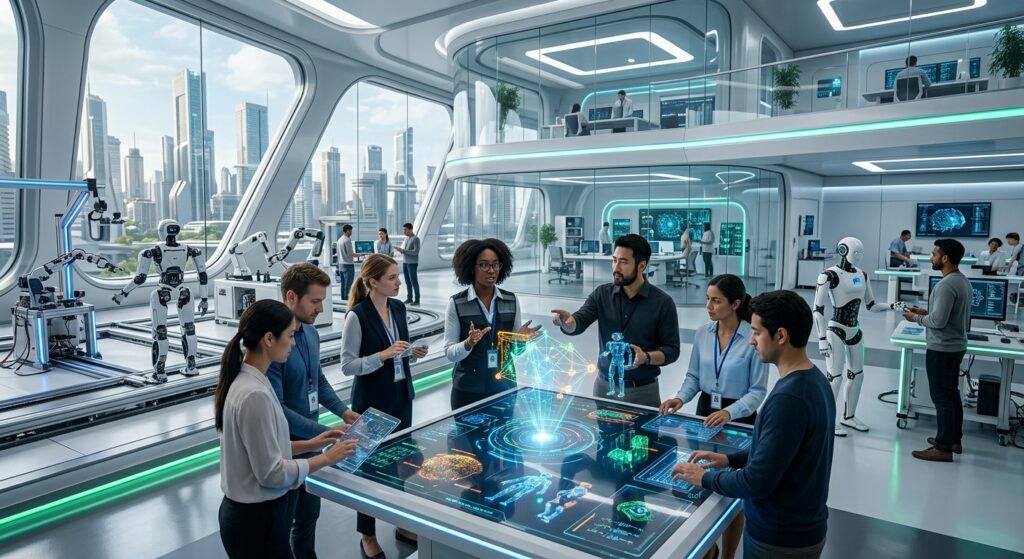
Prometheus, the groundbreaking AI startup co-founded by Jeff Bezos and Vijay Bajaj, has successfully raised $12 billion, achieving a valuation of $41 billion. The funding follows an earlier round of $6.2 billion and aims to create advanced software systems capable of automating complex engineering tasks.
Highlights
- Prometheus raises $12 billion to advance AI technology, reaching a valuation of $41 billion.
- Co-founded by Jeff Bezos, the company aims to automate large segments of engineering work with its “artificial general engineer.”
- Amid contrasting views on AI’s impact on employment, Bezos believes AI will create a labor scarcity, enhancing living standards.
Introducing Prometheus and Its Ambitious Vision
In a significant move in the tech sector, Prometheus, a pioneering AI startup co-founded by billionaire Jeff Bezos and influential tech entrepreneur Vijay Bajaj, has announced a substantial funding round raising $12 billion. This financial injection raises the company’s valuation to an impressive $41 billion. The contributions came from prominent investors including JPMorgan Chase, Goldman Sachs, and BlackRock, further signalling the growing investor confidence in artificial intelligence technologies. The latest funding round follows an initial raise of $6.2 billion last year, and the company is making bold strides toward reshaping the engineering landscape.
Prometheus aims to develop what it terms as an “artificial general engineer,” a cutting-edge software designed to automate the intricate processes involved in designing and manufacturing complex physical systems, such as jet engines and pharmaceutical compounds. The significant ambition here is not only to enhance productivity in engineering sectors but also to redefine labor dynamics in the age of automation. This pioneering concept positions Prometheus at the forefront of the AI revolution, drawing both interest and skepticism from various sectors of the technology landscape.
Core Goals and Implications of “Labor Scarcity”
At the heart of Prometheus’s mission is the vision to replace extensive portions of engineering tasks with artificial intelligence, thereby streamlining and optimizing productivity across industries. Interestingly, while many technology leaders express concern over potential job loss due to automation, Bezos presents a contrasting perspective. He describes the potential for “labor scarcity,” acknowledging a future where the demand for human workers can outstrip supply due to exponential technological advancement. This outlook emphasizes a significant transition where productivity gains could potentially elevate the standard of living.
In Bezos’s view, increased automation may lead to more efficient household structures, with a shift from dual-income to single-income households as productivity increases. However, this perspective invites critical discussions on the ethical implications of AI on employment. The company’s current workforce of 150 employees, spread across global offices in San Francisco, London, and Zurich, suggests that Prometheus is already making strides in establishing a solid foundation for its ambitious ambitions.
The Future of Physical AI
Prometheus stands out as one of the most highly valued startups in the AI sector, and its latest funding is a testament to the burgeoning interest in physical AI technologies. Investors appear to be rallying around companies that present tangible applications in the physical world, which many believe provide unique and sustainable competitive advantages over traditional software solutions. The rationale is that, unlike software alone, physical systems create moats that cannot be quickly replicated, enhancing the long-term viability of these technologies in the marketplace.
More broadly, the rapid influx of investment in the physical AI sector showcases a fundamental shift in how automation is perceived within the tech ecosystem. As Prometheus continues to develop its groundbreaking technologies, it raises critical questions about the future role of human labor in an increasingly automated world and the ethical implications that come with it. What happens to those currently employed in sectors facing automation? How should education systems adapt to prepare future workers for a landscape drastically altered by AI?
In conclusion, Prometheus is poised to make transformative changes in engineering and automation. Its substantial funding success reflects a strong belief in the potential for AI to reshape industries. However, with such transformation comes the responsibility to address the human implications of these advancements. How will societies adapt to an increasingly automated reality? What policies should be put in place to support workers displaced by such technologies? These questions warrant a thoughtful discussion as we venture into this new era of technology.
Editorial content by Skyler Grey